

Send Message
Privacy statement: Your privacy is very important to Us. Our company promises not to disclose your personal information to any external company with out your explicit permission.
 Suzhou Delfino Environmental Technology Co., Ltd.
Select Language
English
The secondary water supply of domestic drinking water refers to the form of water supply that transfers tap water to users for daily drinking through water storage equipment and pressurization and water purification facilities. The secondary water supply is mainly established to make up for the lack of pressure in municipal water supply pipelines and to ensure water use for high-rise people. Compared with raw water supply, the water quality of secondary water supply is more likely to be polluted because it has to go through more links. Therefore, it is very important to test and manage the drinking water quality of the secondary water supply.
Sampling points are generally set at the raw water inlet, equipment outlet, terminal waterAdditional measurement items: ammonia nitrogen, nitrite nitrogen, oxygen consumption
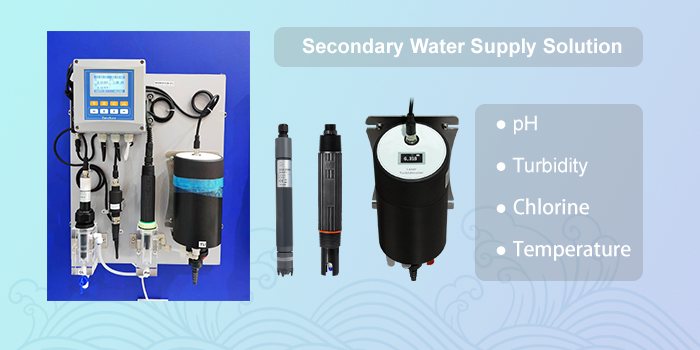
The multi-parameter water quality analysis instrument developed and produced by Delfino can continuously monitor water quality pH, temperature, turbidity and residual chlorine value. MCC200 is a multi-parameter controller that can connect 2-4 identical or different digital sensors at the same time to realize water quality analysis. Real-time monitoring of multiple parameters. It comes with a RS485 digital communication and supports Modbus communication protocol. If customers need current and relays, we have matching external expansion modules, which are easy to use. The sensors used in the secondary water supply multi-parameter scheme are also digital. Digital pH Sensor, with PPS shell, IP68 protection level, long service life. The low Turbidity Sensor adopts the laser method and can measure the turbidity value in the range of 0~100NTU. The film-covered amperometric system adopted by the residual Chlorine Sensor has a long service life and low maintenance. In addition to the use of electrolyte, it does not need to consume chemical reagents.
Specification
| Parameter | pH | Turbidity | Chlorine |
| Measuring range | 0~14pH | 0~100NTU | 0~2ppm |
| Principle | Electrochemical glass electrode | 660 nm Laser Scattering Principle | membrane-covered, ampere |
| Resolution | 0.01pH | 0.001NYU | 0.01ppm |
| Accuracy | 0.1%FS | 0.001~40NTU ±2%;40~100NTU ±5% | <1% |
| Communication | RS485 | RS485 | 4-20mA or RS485 |
| Compensation | temperature | temperature |
If you are interested in our set of multi-parameter instrument solutions for secondary water supply, please contact us. Delfino focuses on the R&D, production and sales of water quality analysis instruments. Its main products include online pH ORP analyzer, conductivity analyzer, turbidity analyzer, dissolved oxygen analyzer, COD analyzer, ammonia analyzer, chlorine analyzer, etc. If you need water treatment related products, please contact us.
September 25, 2024
August 27, 2024

November 07, 2023

October 20, 2023
In the field of water quality monitoring and analysis, Daruifuno's water quality instrument development team has stringent requirements on the performance of sensors, especially for waterproof...
Overview As a high-precision water quality monitoring device, the signal detection process of fluorescent dissolved oxygen sensor involves knowledge and technology in multiple fields such as optics,...
Introduction to Electrode Glass Membrane The electrode glass membrane, a critical component in pH electrodes, possesses a series of unique properties that make it suitable for use in harsh...
Overview Water quality is a critical factor in environmental protection, industrial processes, and public health. Effective monitoring and control help maintain safe drinking water, optimize...
Email to this supplier
September 25, 2024
August 27, 2024
November 07, 2023
October 20, 2023
About Us
Related Products List
Contact Us

Send Inquiry
Privacy statement: Your privacy is very important to Us. Our company promises not to disclose your personal information to any external company with out your explicit permission.
Fill in more information so that we can get in touch with you faster
Privacy statement: Your privacy is very important to Us. Our company promises not to disclose your personal information to any external company with out your explicit permission.