

Send Message
Privacy statement: Your privacy is very important to Us. Our company promises not to disclose your personal information to any external company with out your explicit permission.
 Shenzhen DOSZ Technology Co., Ltd.
Select Language
English
A water turbidity analyzer, also known as a turbidimeter or turbidity meter, is an indispensable tool in water quality monitoring. It characterizes the clarity and transparency of water bodies by measuring the scattering and absorption of light by suspended matter in water, serving as a critical indicator in assessing water quality conditions. This article will provide a detailed introduction to the working principle, types, application scenarios, advantages, and disadvantages of water turbidity analyzers.
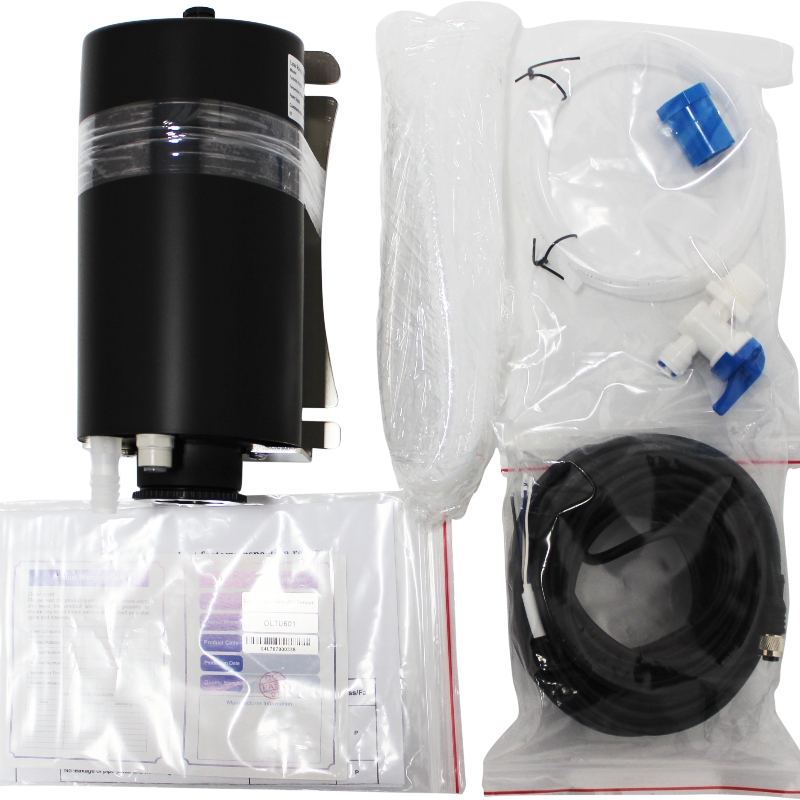
Water turbidity analyzers primarily operate based on optical principles. When light passes through water, it encounters suspended particles (such as soil, dust, fine organic matter, plankton, and microorganisms), which scatter and absorb some of the light. Based on the direct proportionality between the intensity of scattered light and the turbidity of the water, the turbidity of the water body can be determined by measuring the intensity of scattered light.
Common measurement principles include:
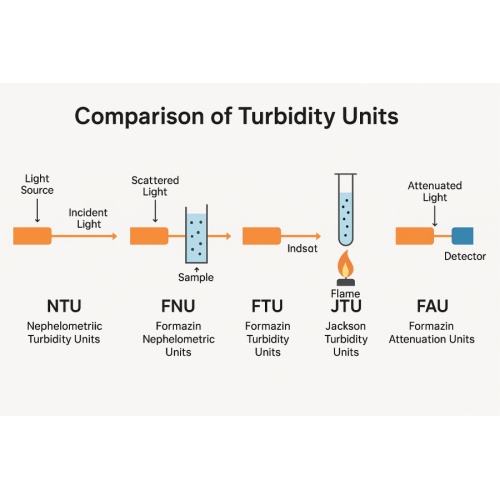
Scattered Light Method: Utilizes a scatterer with a 90-degree scattering angle to measure the intensity of scattered light, and calculates the turbidity of the water. This method, based on the Rayleigh formula, corrects for the influence of color and light-absorbing substances on the measurement by calculating the ratio of scattered to incident light intensity.
Transmitted Light Method: Determines turbidity by measuring the intensity of light transmitted through the water body. However, this method is significantly influenced by water color and light-absorbing substances, often used in conjunction with the scattered light method for improved accuracy.
Laser Diffraction Method: Uses laser irradiation of suspensions to obtain particle size and distribution information through diffraction, thereby determining the turbidity of the water. This method offers high sensitivity and precision.
Optical Scattering Method: Integrates components such as light sources, scatterers, and detectors to measure the relationship between scattered light intensity and scattering angle, thereby determining the turbidity of the water.
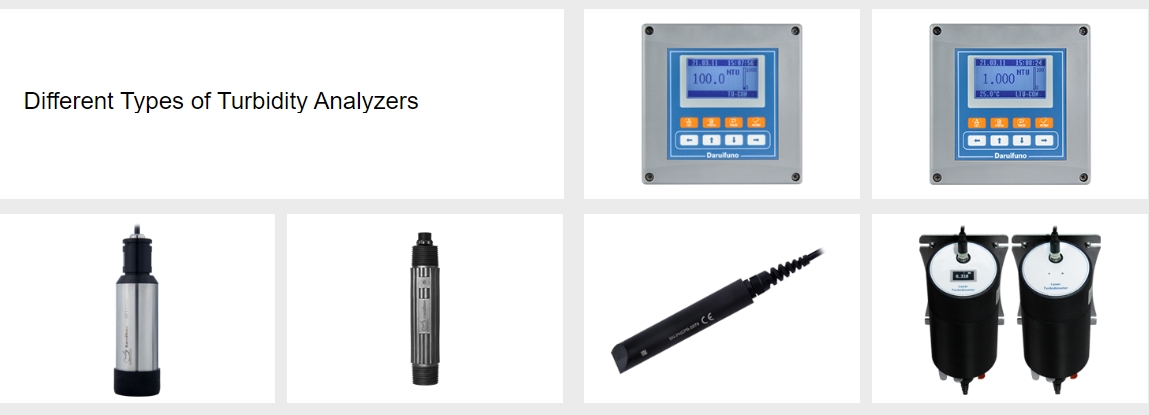
Water turbidity analyzers can be classified into two main categories based on their application scenarios and functional characteristics: portable turbidity meters and online turbidity analyzers.
Portable Turbidity Meters: Designed to be compact and portable, suitable for use in the field, on-site, or in environments requiring frequent changes of measurement points. They typically offer fast, accurate, and easy-to-operate features but are limited by sensor lifespan and measurement range.
Online Turbidity Analyzers: Equipped with microprocessors and powerful functions, capable of continuously monitoring changes in water turbidity. They often feature backlit LCD screens, data storage capabilities, and relay control outputs, making them suitable for applications such as water treatment plants, sewage treatment plants, and industrial process water monitoring.
Water turbidity analyzers have a wide range of applications, including but not limited to:
Water Treatment: Real-time monitoring of raw and treated water turbidity in water treatment plants to ensure water quality meets standards.
Environmental Monitoring: Monitoring water quality in rivers, lakes, reservoirs, and other natural water bodies to help environmental departments detect water pollution issues promptly.
Food Processing and Pharmaceutical Industries: Turbidity is a critical indicator of raw material purity and product quality, making turbidity analyzers essential in these industries.
Wastewater Treatment: Monitoring turbidity during wastewater treatment processes to help operators adjust treatment processes in a timely manner.
Industrial Process Water Monitoring: Used in industries such as power, steel, and petrochemicals to monitor water quality changes and optimize treatment processes.
Environmental Monitoring Networks: Including municipal water pipe network monitoring, water quality monitoring in seawater and freshwater aquaculture farms, providing a comprehensive understanding of water conditions.
Oceanographic Research: Turbidity is a key parameter in measuring seawater clarity, and turbidity analyzers enable real-time monitoring of turbidity changes in oceanographic research.
Advantages:
Disadvantages:
In summary, water turbidity analyzers play a vital role in water quality monitoring. Their working principles, types, application scenarios, advantages, and disadvantages should be comprehensively considered based on actual needs to optimize their use.

September 25, 2024

August 27, 2024

November 07, 2023

October 20, 2023
In the field of water quality monitoring and analysis, DOSZ's water quality instrument development team has stringent requirements on the performance of sensors, especially for waterproof...
Overview As a high-precision water quality monitoring device, the signal detection process of fluorescent dissolved oxygen sensor involves knowledge and technology in multiple fields such as optics,...
Introduction to Electrode Glass Membrane The electrode glass membrane, a critical component in pH electrodes, possesses a series of unique properties that make it suitable for use in harsh...
Overview Water quality is a critical factor in environmental protection, industrial processes, and public health. Effective monitoring and control help maintain safe drinking water, optimize...
Email to this supplier
September 25, 2024
August 27, 2024
November 07, 2023
October 20, 2023
About Us
Related Products List
Contact Us

Send Inquiry
Privacy statement: Your privacy is very important to Us. Our company promises not to disclose your personal information to any external company with out your explicit permission.
Fill in more information so that we can get in touch with you faster
Privacy statement: Your privacy is very important to Us. Our company promises not to disclose your personal information to any external company with out your explicit permission.