

Send Message
Privacy statement: Your privacy is very important to Us. Our company promises not to disclose your personal information to any external company with out your explicit permission.
 Suzhou Delfino Environmental Technology Co., Ltd.
Select Language
English
Water quality monitoring stands as a cornerstone in environmental management systems, offering real-time insights into aquatic ecosystems and their dynamic changes. It underpins informed decision-making for pollution control, resource management, and sustainable environmental planning. Central to this monitoring infrastructure is Conductivity Sensor technology, which is indispensable across industries like chemical processing, environmental conservation, and marine research.
?
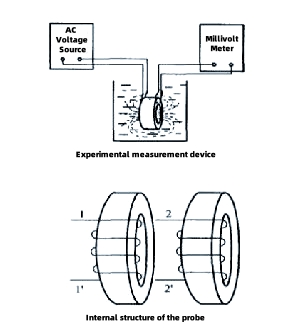
Inductive conductivity sensors, functioning on the principle of electromagnetic induction, enable contactless conductivity measurement, earning them the moniker "non-polar conductivity meters." These sensors employ a dual magnetic ring coil probe encased within a robust polymer body. As conductive liquids form a closed loop within the sensor's aperture, electromagnetic induction occurs between the coils, generating a primary excitation signal and a secondary induction response. Notably, the liquid acts as a magnetic core, with higher conductivity liquids producing stronger output signals.
?
The design of inductive conductivity sensors is a marvel of engineering, featuring a dual-coil configuration within a corrosion-resistant polymer housing. This electrode-free design circumvents common issues such as electrode corrosion, polarization, and scaling, thereby enhancing sensor stability and reliability while minimizing maintenance. Their robustness against corrosive substances makes them ideal for harsh environments in chemical, food, and pharmaceutical industries.
?
Conductivity sensors are broadly categorized into electrode-type, electromagnetic, and ultrasonic varieties, each suited to specific applications:
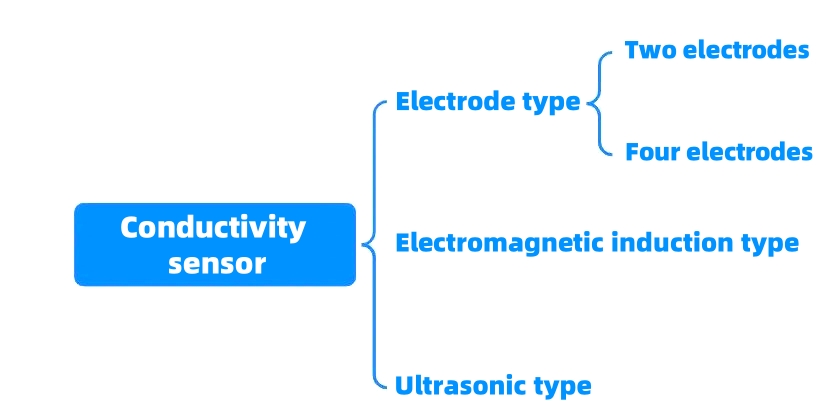
The most conventional form, these sensors measure conductivity using electrolytic principles. They are further divided into two-electrode and four-electrode designs. Two-electrode sensors apply a constant voltage across electrodes to measure resistance changes, while four-electrode sensors use coaxial current and voltage electrodes to reduce polarization effects, enhancing accuracy.
Leveraging electromagnetic induction, these sensors excel in precision and electromagnetic interference resistance, making them suitable for complex industrial settings.
These sensors assess conductivity by analyzing ultrasonic wave propagation changes in liquids, utilizing reflection and scattering phenomena for measurement.
?
Electromagnetic induction conductivity sensors represent a significant advancement in water quality monitoring, offering unparalleled advantages in harsh environments and complex industrial applications. Their non-contact measurement capabilities and robust design make them a preferred choice for ensuring accurate, reliable, and maintenance-free conductivity monitoring.
September 25, 2024
August 27, 2024

November 07, 2023

October 20, 2023
In the field of water quality monitoring and analysis, Daruifuno's water quality instrument development team has stringent requirements on the performance of sensors, especially for waterproof...
Overview As a high-precision water quality monitoring device, the signal detection process of fluorescent dissolved oxygen sensor involves knowledge and technology in multiple fields such as optics,...
Introduction to Electrode Glass Membrane The electrode glass membrane, a critical component in pH electrodes, possesses a series of unique properties that make it suitable for use in harsh...
Overview Water quality is a critical factor in environmental protection, industrial processes, and public health. Effective monitoring and control help maintain safe drinking water, optimize...
Email to this supplier
September 25, 2024
August 27, 2024
November 07, 2023
October 20, 2023
About Us
Related Products List
Contact Us

Send Inquiry
Privacy statement: Your privacy is very important to Us. Our company promises not to disclose your personal information to any external company with out your explicit permission.
Fill in more information so that we can get in touch with you faster
Privacy statement: Your privacy is very important to Us. Our company promises not to disclose your personal information to any external company with out your explicit permission.