

Send Message
Privacy statement: Your privacy is very important to Us. Our company promises not to disclose your personal information to any external company with out your explicit permission.
 Shenzhen DOSZ Technology Co., Ltd.
Select Language
English
With the continuous acceleration of industrialization and urbanization, water pollution problems are becoming more and more serious. How to correctly treat sewage has become the number one problem in the construction of modern cities. As an important water treatment technology, reverse osmosis technology is widely used in various fields. Water quality analysis instruments such as pH analyzer, conductivity analyzer, and ammonia nitrogen analyzer will be used in reverse osmosis water quality monitoring. So what are the standards for effluent quality in reverse osmosis treatment?
Revers osmosis technology is a technology that uses semipermeable membranes to separate solutions. Reverse osmosis water treatment equipment usually consists of a pretreatment system, a reverse osmosis unit and a residual solute treatment system. Its basic working principle is to use high-precision semi-permeable membranes to effectively separate and remove pollutants and inorganic substances such as ions, macromolecular organic matter, colloidal particles, etc. dissolved in the water through pressure or chemical reaction, thereby achieving water desalination and pollutant removal purposes.
The water quality of the reverse osmosis water treatment device must comply with relevant national water quality standards. Usually, the effluent quality standards for reverse osmosis water treatment are as following:
Total dissolved solids (TDS): ≤500mg/L
Conductivity: ≤1.0ms/cm
Hardness: ≤ 0.03mmol/L
pH value: 6~8pH
Ammonia nitrogen: ≤0.15mg/L
Total phosphorus: ≤0.1mg/L
Total nitrogen: ≤15mg/L
Chloride ion: ≤250mg/L
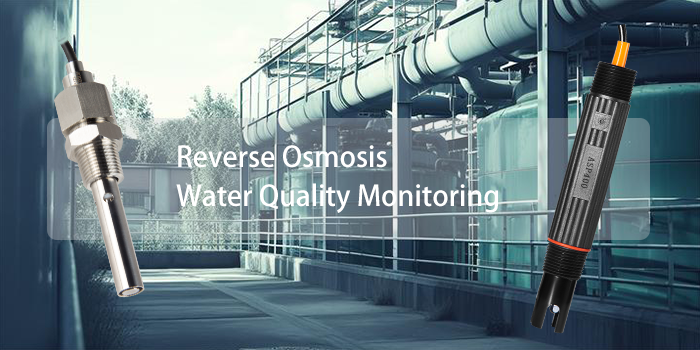
Other harmful substances such as copper, cadmium, mercury, arsenic, hexavalent chromium and other harmful substances need to comply with relevant national standards. According to the effluent standards of reverse osmosis water quality, DOSZ brand online Conductivity Controller can be used with ASCK series stainless steel conductivity sensors to monitor the conductivity value RO effluent. At the same time, the conductivity controller can also display the TDS value through the setting of the conversion coefficient. To monitor the pH value, you can use the APX series online pH controller with the ASP400 PH Sensor to accurately monitor the pH value of water quality in real time.
To ensure the water quality of the reverse osmosis water treatment device, the following aspects need to be considered:
Equipment quality: Choosing a high quality reverse osmosis water treatment device produced by a regular manufacturer is the first condition to ensure the quality of effluent water.
Equipment operation: The operation status, operating methods, cleaning cycles, etc. of the reverse osmosis water treatment device will affect the quality of the effluent water. Therefore, operation and management should be carried out strictly in accordance with the equipment instructions.
Water source quality: reverse osmosis water treatment equipment is suitable for various water sources, but the characteristics of different water sources require different pretreatments and the addition of different chemicals to ensure the quality of the effluent water. The use of high-quality and reliable water quality analysis instruments is very important for monitoring the quality of effluent. Delifno focuses on the R&D and production of water quality analysis instruments. Its main products include pH ORP analyzer, conductivity analyzer, turbidity analyzer, COD analyzer, dissolved oxygen analyzer, ammonium analyzer, chlorine analyzer, etc.
Maintenance: After the reverse osmosis water treatment equipment has been used for a period of time, scale is likely to accumulate inside the membrane element, and bacteria and algae can grow, which seriously affects the operation of the reverse osmosis membrane. Therefore, regular maintenance is required, including cleaning the reverse osmosis membrane and replacing membrane elements.
The quality of the water effluent from the reverse osmosis water treatment device is affected by many factors, such as the quality of the water source, the material and operating temperature of the reverse osmosis membrane, and the processing capacity of the reverse osmosis water treatment device. However, in general, the water quality of the reverse osmosis water treatment device is superior to traditional water treatment methods(such as sand filtration, coagulation sedimentation, activated carbon adsorption, etc.), and there is no need to use chemicals. The reason why the effluent quality of the reverse osmosis water treatment device is relatively good is that the size of the reverse osmosis membrane is only 0.1nm, which can completely filter out ions, macromolecular organic matter and large particles of colloids. As a result, the filtered water is cleaner, more transparent, tastes better, and is more suitable for direct drinking water.
As an efficient and environmentally friendly desalination technology, reverse osmosis water treatment technology has a wide range of application. In real life, reverse osmosis water treatment equipment is used to prepare domestic water, drinking water, and industrial water. It can also solve pollution problems such as high salinity and alkalinity in groundwater and river water, heavy metals, and bacteria. It is a very important method. In the process of reverse osmosis water treatment, it is also very necessary to correctly use and online Water Quality Analyzer to monitor the effluent. In today's world of water shortage, serious water pollution problems, and rapid social and economic development, reverse osmosis water treatment devices are of very important practical significance to ensure the safety of water supply, improve the quality of life, and reduce the pressure on water resources.
September 25, 2024
August 27, 2024

November 07, 2023
October 20, 2023
In the field of water quality monitoring and analysis, DOSZ's water quality instrument development team has stringent requirements on the performance of sensors, especially for waterproof...
Overview As a high-precision water quality monitoring device, the signal detection process of fluorescent dissolved oxygen sensor involves knowledge and technology in multiple fields such as optics,...
Introduction to Electrode Glass Membrane The electrode glass membrane, a critical component in pH electrodes, possesses a series of unique properties that make it suitable for use in harsh...
Overview Water quality is a critical factor in environmental protection, industrial processes, and public health. Effective monitoring and control help maintain safe drinking water, optimize...
Email to this supplier
September 25, 2024
August 27, 2024
November 07, 2023
October 20, 2023
About Us
Related Products List
Contact Us

Send Inquiry
Privacy statement: Your privacy is very important to Us. Our company promises not to disclose your personal information to any external company with out your explicit permission.
Fill in more information so that we can get in touch with you faster
Privacy statement: Your privacy is very important to Us. Our company promises not to disclose your personal information to any external company with out your explicit permission.