

Send Message
Privacy statement: Your privacy is very important to Us. Our company promises not to disclose your personal information to any external company with out your explicit permission.
 Suzhou Delfino Environmental Technology Co., Ltd.
Select Language
English
?
A hydrogen fuel cell is a device that generates electrical energy through the chemical reaction of hydrogen and oxygen. In order to ensure the uniformity of the temperature distribution of the fuel cell, the temperature difference between the inlet and outlet coolant generally does not exceed 10°C. For high-power fuel cells, the heat is generally taken away through specially treated water, and then dissipated through an external cooling device. Hydrogen fuel cells have strict requirements on cooling water temperature, inlet and outlet water temperature difference and water flow rate. Generally, the inlet temperature of the coolant is controlled at about 65°C, and the outlet temperature is controlled at about 75°C. The control accuracy is high, and it is generally required to be within the specified value ± Within the range of 1℃, the degree of guarantee of the temperature difference between the water temperature and the inlet and outlet water will directly affect the performance and life of the battery. About 95% of the waste heat needs to be taken away through cooling water. This shows that the heat dissipation of the fuel cell engine through the cooling system is relatively high. Coolant plays a very important role in the workflow of the entire system. Its relevant technical parameters, shape, material matching, cleaning and other work before filling determine the normal use, operating life, maintenance cost, etc. of the stack.
The first and most important indicator of hydrogen fuel coolant is that the conductivity needs to be less than 5 μS/cm, but in actual applications, the conductivity is required to be less than 2 μS/cm before being installed in the vehicle. Because although the stack, radiator, pipes, etc. have been cleaned, some ions may be precipitated. Therefore, conductivity sensors and transmitters are required to monitor the conductivity of the coolant.
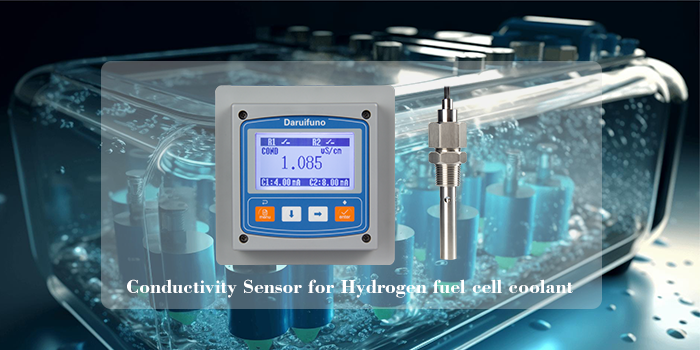
The online conductivity analyzer developed and produced by Daruifuno includes a Conductivity Sensor and a Conductivity Controller. Conductivity sensors currently provide three measurement ranges: 0.05~20μS/cm, 0.5~200μS/cm, and 5~2000μS/cm. Usually the water quality involved in the coolant is deionized water or ultrapure water, and the range is very low. You can choose an electrode with a K constant of 0.01.
The advantages of our conductivity electrodes are:
1. Built-in PT1000 high-precision temperature sensor;
2. All made of 316L stainless steel
3. 1/2NPT thread, easy to install, the thread can also be customized
4. Measuring temperature between 0~100℃, pressure 0~5bar
?
The features of the AEC1-T conductivity controller are:
1. 3.2-inch LCD display
2. 2 SPST relays, 2 channels of 4-20mA current
3. RS485 function can be configured or not.
4. Automatically identify the K constant of the sensor
5. Provide 5-point calibration
6. Automatic or manual temperature compensation function
?
This online conductivity analyzer is used by many customers to monitor ultrapure water, pure water, and deionized water. If you are interested in our products, please contact us! Delfino company focuses on the R&D, production and sales of water quality analysis instruments. Its main products include online pH ORP analyzer, conductivity analyzer, turbidity analyzer, dissolved oxygen analyzer, COD analyzer, ammonia analyzer, suspend solid sensor, chlorine analyzer, etc. If you need water treatment related products, please contact us.
?

September 25, 2024
August 27, 2024

November 07, 2023

October 20, 2023
In the field of water quality monitoring and analysis, Daruifuno's water quality instrument development team has stringent requirements on the performance of sensors, especially for waterproof...
Overview As a high-precision water quality monitoring device, the signal detection process of fluorescent dissolved oxygen sensor involves knowledge and technology in multiple fields such as optics,...
Introduction to Electrode Glass Membrane The electrode glass membrane, a critical component in pH electrodes, possesses a series of unique properties that make it suitable for use in harsh...
Overview Water quality is a critical factor in environmental protection, industrial processes, and public health. Effective monitoring and control help maintain safe drinking water, optimize...
Email to this supplier
September 25, 2024
August 27, 2024
November 07, 2023
October 20, 2023
About Us
Related Products List
Contact Us

Send Inquiry
Privacy statement: Your privacy is very important to Us. Our company promises not to disclose your personal information to any external company with out your explicit permission.
Fill in more information so that we can get in touch with you faster
Privacy statement: Your privacy is very important to Us. Our company promises not to disclose your personal information to any external company with out your explicit permission.