

Send Message
Privacy statement: Your privacy is very important to Us. Our company promises not to disclose your personal information to any external company with out your explicit permission.
 Shenzhen DOSZ Technology Co., Ltd.
Select Language
English
The OPD700 Dissolved Oxygen Sensor supports one-point calibration and two-point calibration. One-point calibration is 100% full-scale calibration. Usually, one-point calibration can meet most usage requirements. Adding zero-point calibration on the basis of 100% saturation calibration is two-point calibration. If the measured dissolved oxygen concentration is relatively low, a two-point calibration is required to obtain more accurate data.
One-point calibration method?
1. Water-saturated air calibration
This is a relatively simple and fast 100% calibration method. prepare a beaker or bottle, put distilled water in it, and place the sensor vertically about 2cm above the water surface. At this time, above the water surface in an environment of 100% air humidity, the saturation of dissolved oxygen is 100%, so it can be used as a dissolved oxygen sensor full-scale calibration environment.
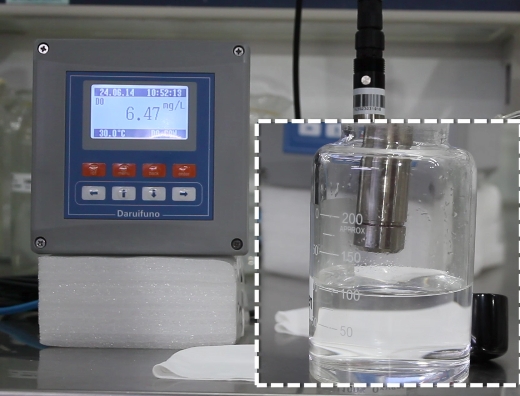
If the conditions on site are limited and time is tight, you can even place the Dissolved Oxygen Probe directly in the air for full calibration. When using the air calibration method, be careful not to touch the temperature sensor at the end of the sensor with your hands, otherwise it will cause inaccurate temperature and affect the calibration accuracy. Wait for the value to stabilize before starting calibration.
Note that when calibrating in air, there should be no water droplets on the membrane cover of the sensor.
Zero-point calibration method
Zero point calibration needs to be performed on the basis of 100% calibration completion. We need to prepare oxygen-free water. Dissolve 50g of anhydrous sodium sulfite in 1000mL of distilled water and stri until completely dissolved.
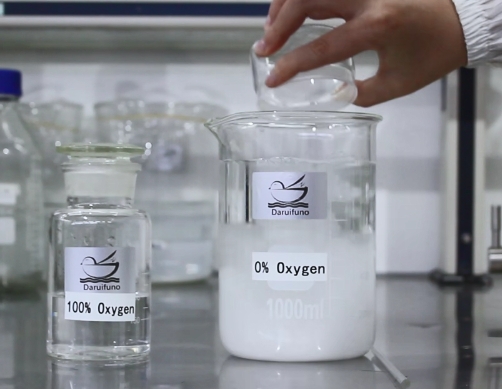
Put the DO Sensor into oxygen-free water, and note that the temperature sensor at the tail should also be completely immersed in the water. Wait for the value to stabilize and start zero point calibration.
After the calibration is completed, immediately use clean water to rinse the residual sodium sulfite solution on the surface of the sensor before putting it into use or storage.
Do not let the dissoloved oxygen sensor soak in oxygen-free water for a long time, otherwise the membrane cover will be damaged.
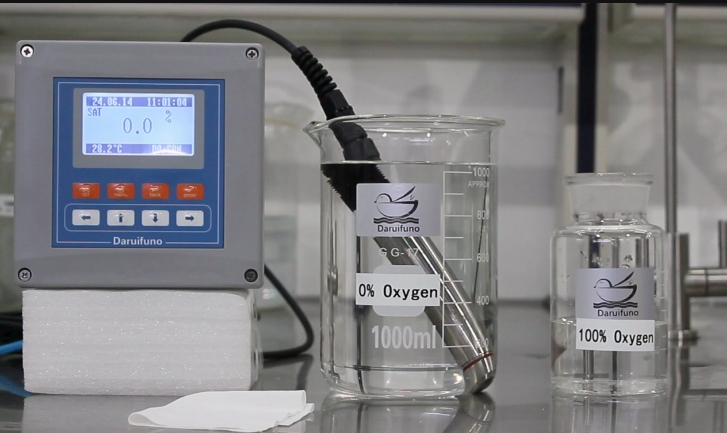
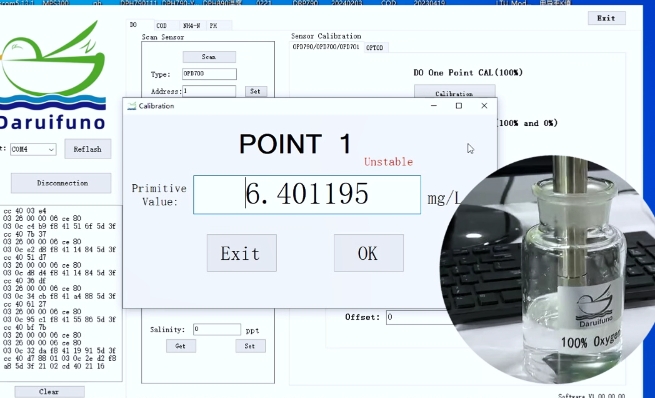
Delfino focuses on the research and development and production of water quality analysis instruments. Its main products include pH ORP analyzer, conductivity analyzer, turbidity analyzer, COD analyzer, dissolved oxygen analyzer, ammonium analyzer, chlorine analyzer, etc.Our company provides matching online dissolved oxygen controllers for calibration, and also provides computer software for calibration. Users can also use their computer software for calibration. Users can also use their own modbus software for calibration. For specific operation details, please contact sales staff.
September 25, 2024

August 27, 2024

November 07, 2023

October 20, 2023
In the field of water quality monitoring and analysis, DOSZ's water quality instrument development team has stringent requirements on the performance of sensors, especially for waterproof...
Overview As a high-precision water quality monitoring device, the signal detection process of fluorescent dissolved oxygen sensor involves knowledge and technology in multiple fields such as optics,...
Introduction to Electrode Glass Membrane The electrode glass membrane, a critical component in pH electrodes, possesses a series of unique properties that make it suitable for use in harsh...
Overview Water quality is a critical factor in environmental protection, industrial processes, and public health. Effective monitoring and control help maintain safe drinking water, optimize...
Email to this supplier
September 25, 2024
August 27, 2024
November 07, 2023
October 20, 2023
About Us
Related Products List
Contact Us

Send Inquiry
Privacy statement: Your privacy is very important to Us. Our company promises not to disclose your personal information to any external company with out your explicit permission.
Fill in more information so that we can get in touch with you faster
Privacy statement: Your privacy is very important to Us. Our company promises not to disclose your personal information to any external company with out your explicit permission.