
 Contact Now

Send Message
Privacy statement: Your privacy is very important to Us. Our company promises not to disclose your personal information to any external company with out your explicit permission.
 Suzhou Delfino Environmental Technology Co., Ltd.
Select Language
English



| Measuring range | |
| option | |
| Contact Now |


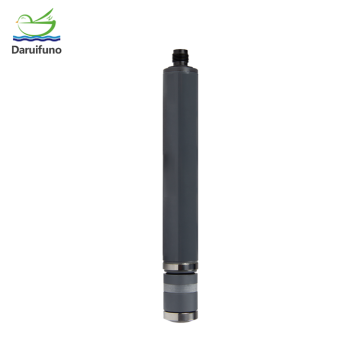
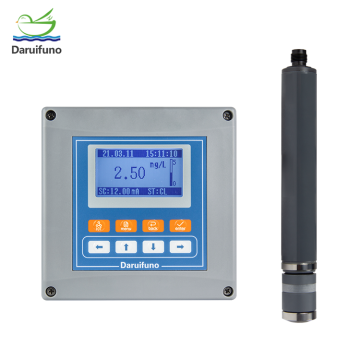
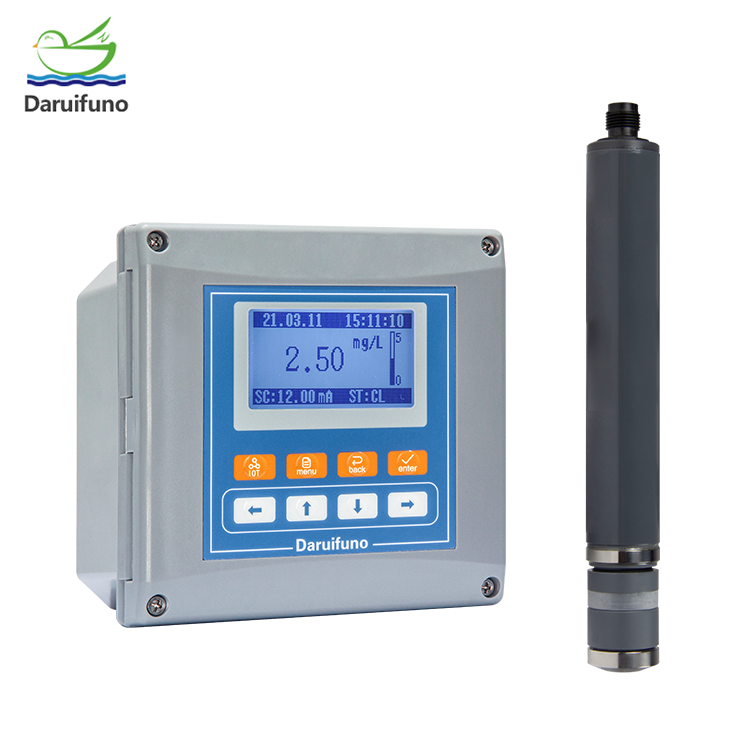
Chlorine is one of the common water treatment agents used to disinfect tap water from bacteria and pathogens. Monitoring the total chlorine value at the waterworks can ensure that the concentration of chlorine disinfectants in the tap water is within a safe range, which can effectively kill bacteria and pathogens without adversely affecting human health. In addition, monitoring the total chlorine value can also detect leakage or excessive dosage of chlorine disinfectant in tap water in time to ensure the quality and safety of tap water. Chlorine disinfection is generally in the final process of raw water treatment, coagulation sedimentation, filtration and water treatment, so it is very necessary to use a Total Chlorine Sensor to monitor total chlorine. It is necessary to choose a total Chlorine Sensor with good stability, fast response, and convenience. Daruifuno's CP4 total chlorine sensor is a membrane-covered amperometric system with long service life and low maintenance. We also have a matching total chlorine controller that can display, control and output data.
Features
The total chlorine sensor is compact and lightweight, and can be directly immersed in the flow cell for use
The total chlorine sensor adopts the principle of amperometric three-electrode system with film covering method, with stable measurement and real-time response
No reagents are consumed, no chemicals are produced, and low maintenance
The response speed is fast, and the total chlorine value of the water quality can be continuously monitored in real time
Specification
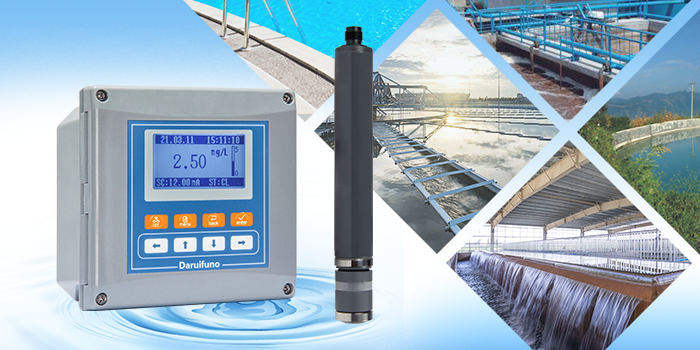
In the waterworks, where are the total chlorine sensors mainly used?
1. Raw water treatment: The raw water of waterworks generally comes from natural water sources such as rivers and lakes, which may contain a large number of bacteria and viruses. In the raw water treatment process, chlorine disinfection is required to kill these microorganisms and ensure water quality safety.
2. Coagulation and sedimentation: In the process of water treatment, coagulants are used to aggregate suspended and turbid substances in the water into agglomerates to form sediments. During the coagulation and sedimentation process, chlorine disinfection is also required to prevent the reproduction of bacteria and viruses.
3. Filtration: After coagulation and sedimentation, the suspended matter and turbid matter in the water will be filtered out by the filter to further improve the water quality. During the filtration process, chlorine disinfection is also required to kill any microorganisms that may be present.
4. Residual disinfection: At the end of the water treatment process, residual disinfection is required to ensure that the tap water will not be contaminated by bacteria and viruses during the transportation process. At this time, an appropriate amount of chlorine disinfectant will be added to achieve a certain residual chlorine value. At this time, the residual chlorine sensor can be used to monitor the residual chlorine value in the water.
Delfino focuses on the R&D, production and sales of water quality analysis instruments. We provide solutions for customers. Our main products include online pH ORP analyzer, conductivity analyzer, turbidity analyzer, COD analyzer, dissolved oxygen analyzer, ammonium analyzer, etc. Our products are suitable for various water treatment occasions, if you are interested in our products, please contact us.
About Us
Related Products List
Contact Us

Send Inquiry


Privacy statement: Your privacy is very important to Us. Our company promises not to disclose your personal information to any external company with out your explicit permission.
Fill in more information so that we can get in touch with you faster
Privacy statement: Your privacy is very important to Us. Our company promises not to disclose your personal information to any external company with out your explicit permission.