


 Contact Now

Send Message
Privacy statement: Your privacy is very important to Us. Our company promises not to disclose your personal information to any external company with out your explicit permission.
 Suzhou Delfino Environmental Technology Co., Ltd.
Select Language
English



| Measuring range | |
| Contact Now |


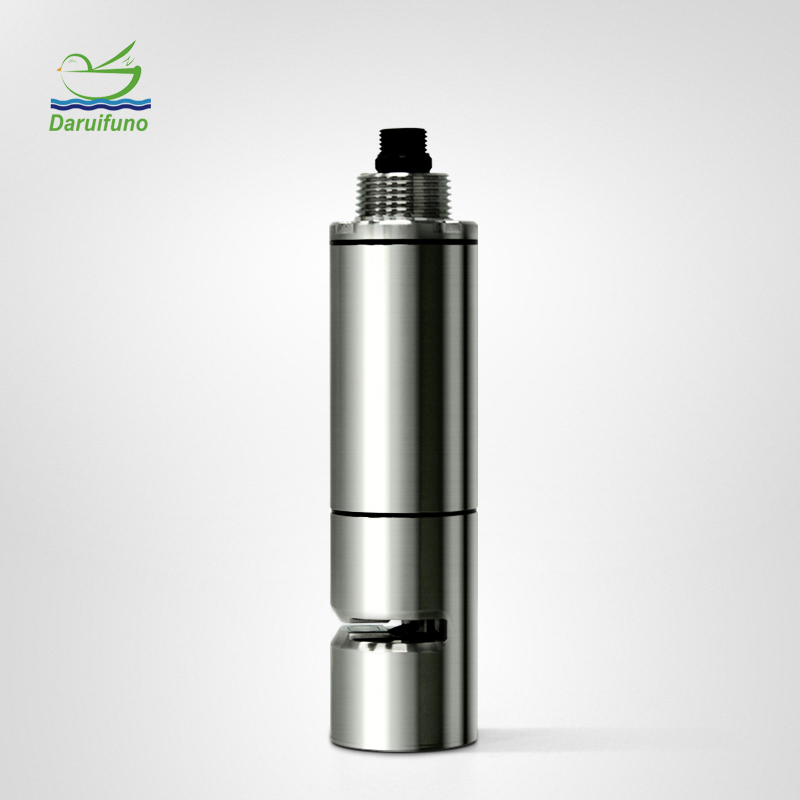
Chemical oxygen demand refers to the amount of oxidant consumed to oxidize reducing substances in one liter of water sample under certain conditions, expressed in mg/L of oxygen. Reducing substances in water include organic substances and inorganic substances such as nitrite, sulfide, and feerous salts. chemical oxygen demand reflects the degree of contamination of water by reducing substances. Since it is a very common phenomenon for water bodies to be polluted by organic matter, this indicator is also used as one of the comprehensive indicators of the relative content of organic matter, but it can only reflect the organic matter oxidized by oxidants. Usually we use a strong oxidant to oxidize the reducing substances in the water sample, and then calculate the oxygen consumption from the amount of remaining oxidant. This method is time-consuming and cannot achieve real-time monitoring. Therefore, in current sewage plants and industrial processes, we will use online COD analyzers. The COD351 online digital COD Sensor developed and produced by Daruifuno uses two light sources, one ultraviolet light is used to measure the COD content in the water, and the other reference light is used to measure the turbidity of the water body. The light path attenuation is compensated through a specific algorithm, which can achieve a certain degree of to eliminate the interference of particular suspended matter, thereby achieving more stable and reliable measurement.
?
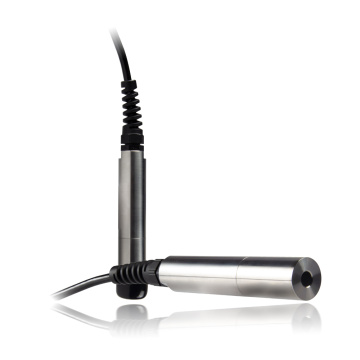
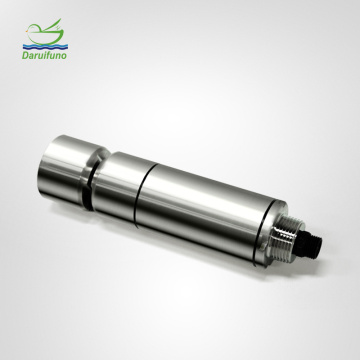
The COD sensor is small in size, easy to install, and has a 1-inch thread on the tail.
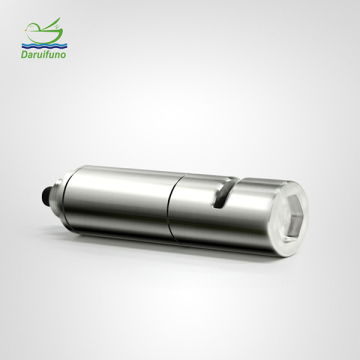
Made of 316L stainless steel, sturdy and durable, with automatic cleaning brush
The COD sensor can measure COD, turbidity and temperature values, and can display TOC values.
Digital sensor, RS485 interface, supports Modbus protocol
?
| Model | COD351 |
| Measuring Principle | UV254 ultraviolet absorption method |
| Measuring Range(COD) | COD351L: 0.75~500mg/L COD351H: 1~1500mg/L |
| Resolution(COD) | 0.01mg/L |
| Accuracy(COD) | ±3%+0.5mg/L |
| Measuring Range(TOC) | COD351L: 0.3~200mg/L COD351H: 0.4~600mg/L |
| Resolution(TOC) | 0.1mg/L |
| Measuring Range(TU) | COD351L: 0~300NTU COD351H: 0~1000NTU |
| Operating Temperature | 0~ 45℃ |
| Protection Grade | IP68 |
| Working Pressure | 1Bar |
| Cleaning Method | Rubber scraper |
| Power | 12~24V DC |
| Output | RS485, Modbus RTU protocol |
| Cable Length | 10m(custom) |
| Shell Material | 316L |
?
Organic matter is very harmful to industrial water systems. When water containing a large amount of organic matter passes through the desalination system, it will contaminate the ion exchange resin, especially the anion exchange resin, which will reduce the resin exchange capacity. Organic matter can be reduced by about 50% during pretreatment (coagulation, clarification and filtration), but it cannot be removed in the desalination system, so it is sometimes brought into the boiler through make-up water, reducing the pH value of the boiler water. Sometimes organic matter may be brought into the steam system and condensate water, lowering the pH and causing system corrosion. High levels of organic matter in circulating water systems can promote microbial growth. Therefore, regardless of desalination, boiler water or circulating water systems, the lower the COD, the better. For example, when the COD (KMnO4 method) in the circulating cooling water system is >5 mg/L, the water quality has begun to deteriorate. Therefore, it is very necessary to use COD sensors to monitor the alkalinity of process water in industrial water systems.
?
About Us
Related Products List
Contact Us

Send Inquiry


Privacy statement: Your privacy is very important to Us. Our company promises not to disclose your personal information to any external company with out your explicit permission.
Fill in more information so that we can get in touch with you faster
Privacy statement: Your privacy is very important to Us. Our company promises not to disclose your personal information to any external company with out your explicit permission.